
Logo Quiz: Guess The Logo Game
Pipi Chick StudioTrivia
4.847.00 Reviews
- Version
- 5.0.2
- Installs
- 500.00K
- Age Rating
- Everyone
Screenshots
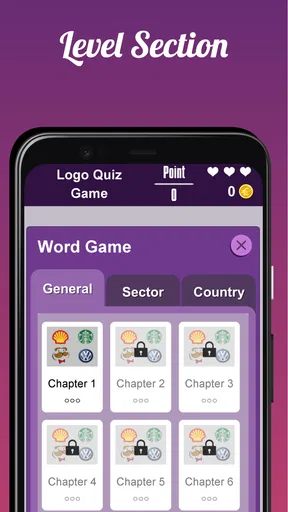
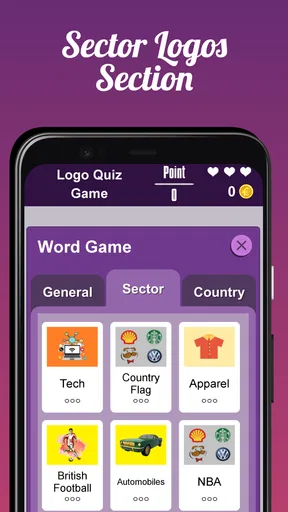
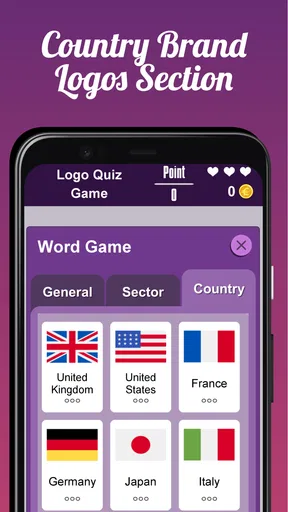
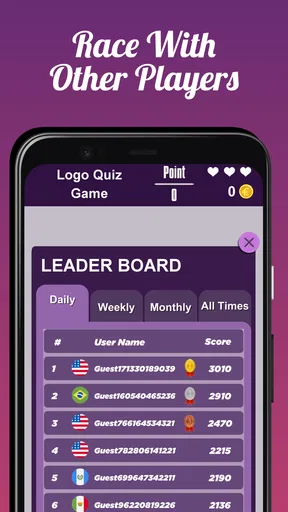
Our Review of Logo Quiz: Guess The Logo Game
 Analysis by Appyee
I enjoy trivia games that are easy to understand within seconds, and Logo Quiz: Guess The Logo Game fits that mood well. It turns brand recognition into a quick guessing challenge: you see a logo, search your memory, and try to identify the company behind it. That simple loop makes it suitable for a short break, a casual challenge with friends, or a longer session when I want something lighter than a strategy or action game.
What makes this particular game worth considering is its approachable scale. It is a free trivia title from Pipi Chick Studio, rated for Everyone, with a 4.8 average from around 4.7 thousand ratings and more than 500 thousand installs. Those figures suggest that it has found a sizeable audience without needing a complicated premise. I also appreciate that the basic idea is immediately clear: there is no long tutorial to study before the first question.
How the current game feels to play
The central appeal is recognition rather than obscure general knowledge. A familiar shape, color arrangement, or partial symbol can be enough to trigger an answer, while less obvious logos make me slow down and examine what I am seeing. That creates a pleasant rhythm between quick wins and moments where I need to think more carefully.
I would describe the experience as a memory test with a visual focus. Instead of asking me to recall a capital city, historical date, or scientific fact, it asks whether I can connect a visual identity with a name. This makes the game feel different from a conventional question-and-answer quiz, even though both rely on the same satisfying moment of getting an answer right.
The strongest use case is a short, interruption-friendly session. If I have a few minutes before an appointment or want something to play while taking a break, a logo question is easier to pick up than a game that requires a long campaign or a carefully planned turn. I can also imagine passing the phone around in a group and seeing who recognizes a logo first. The subject is familiar enough to encourage conversation, especially when one person knows the brand immediately and another remembers only its colors.
That accessibility also explains the Everyone content rating. The concept is suitable for a broad audience, and younger players can participate alongside adults. Still, the difficulty will depend heavily on a player’s exposure to different brands, markets, and product categories. Someone who spends little time around advertising may find certain answers much less obvious than a frequent shopper or a person who follows international companies.
Recognition is the real skill being tested
One useful way to approach the game is to stop treating every question as a pure memory contest. I look first at the outline, then at distinctive color combinations, and finally at any remaining letter or symbol. This order helps me avoid guessing based only on a vague association. It is a small habit, but it makes difficult rounds feel more like deduction than random tapping.
I also find it helpful to say possible answers aloud when playing with someone else. A logo that seems meaningless on a small screen can become recognizable when I describe its visual traits. That turns the game into a compact social activity rather than a solitary test. It is especially effective with mixed-age groups, because different players often recognize different kinds of brands.
Another practical tip is to treat mistakes as information. If a logo feels familiar but I cannot name it, I try to remember where I have seen it: on packaging, in a shop, on a vehicle, or on a screen. That mental context often narrows the possibilities. The game rewards broad everyday awareness more than specialist knowledge, so paying attention to ordinary surroundings can genuinely improve performance.
What the version information tells me
The current version is 5.0.2, while the game was released on February 24, 2022. That combination tells me this is not a brand-new experiment; it has had time to develop beyond its first release. I would not interpret a version number alone as proof of a major redesign, but it does indicate that the product has moved through several iterations instead of remaining at its launch state.
For existing players, that matters mainly because a mature version is usually more reassuring than an untouched first build. The current release is the one I would judge, rather than relying on how the game may have felt when it first appeared. At the same time, I would keep expectations realistic: a higher version number does not automatically mean a deeper game, a larger feature set, or a completely different interface.
The minimum operating-system requirement is Android 7.0, which makes the game accessible to many older Android devices. That is useful if I want to install it on a spare phone or on hardware that is not running a recent system. The trade-off is that older devices can vary in speed and screen quality, so the experience may not feel identical across every phone. I would also check that the display is comfortable for examining small visual details, because logo recognition becomes frustrating when the image is difficult to see.
Where it fits among other trivia games
Compared with a general knowledge quiz, this game is narrower but more immediate. A broad quiz may reward study and factual recall, while this one leans on visual memory and everyday exposure. I prefer the logo format when I want a relaxed challenge that does not make me feel as though I am taking an exam. If my goal were to learn geography, science, or history, I would choose a more specialized trivia app instead.
It also differs from a multiplayer quiz built around speed. The logo format can still create friendly competition, but its appeal is not necessarily frantic reaction time. The interesting question is whether I can recognize the identity, not simply whether I can press a button before another player. That makes it more comfortable for solo play and for people who dislike high-pressure timed rounds.
Against a visual puzzle game, the distinction is the subject matter. A typical image puzzle may ask me to find differences or complete a pattern. Here, the image is a clue to a real-world brand. That makes the game particularly good for players who enjoy noticing packaging, storefronts, technology products, sports identities, and other visual markers in daily life.
How the free model affects the decision
The game is free to download, which lowers the barrier to trying it. That is important for a simple concept: I can decide quickly whether recognizing logos is enjoyable without committing to a purchase first. In-app purchases range from $0.49 to $99.99 per item, so I would pay attention to the purchase screen and avoid treating optional spending as part of the core appeal.
My advice is to begin with the free experience and judge whether it gives you enough entertainment before considering any purchase. A logo quiz works best when the challenge itself is satisfying; buying something should not be necessary to make the basic idea interesting. Parents may also want to supervise purchase settings on a shared device, even though the game’s age rating is Everyone.
The free entry point makes it easy to use in a casual household setting. One person can install it, and others can join in without learning a complicated control scheme. That said, people who dislike advertising, prompts, or any form of optional spending may prefer a paid trivia game with a simpler commercial model. The right choice depends less on the price of entry than on how comfortable you are with the way a free game presents its extras.
What existing players may notice over time
At first, the appeal comes from rapid recognition. Later, the challenge changes because familiar answers become easier and the less obvious ones stand out more. I like that this naturally creates a personal progression: I begin by relying on instant memory, then gradually develop better visual analysis and broader associations.
There is also a social progression. After playing alone, I can use the same questions as conversation starters with friends or family. Someone may know a logo because of a favorite product, while another person recognizes it from work or travel. That makes the game more reusable than a quiz that depends entirely on private study, because the discussion around an answer can be as entertaining as the answer itself.
However, the format has a clear ceiling. Once I have seen many of the recognizable logos, the surprise can diminish. The game is not the best choice for someone seeking a deep narrative, complex strategy, or a constantly changing competitive environment. Its strength is focused repetition, and that same focus can become limiting if I play for long stretches every day.
Remaining friction and who should skip it
The biggest limitation is that brand familiarity is uneven. A player may know the logo of a company they use regularly but struggle with one from another country or industry. That can make some questions feel less like fair reasoning and more like a test of personal shopping habits. I would not use a poor score as a measure of intelligence; it mostly reflects what visual identities a person has encountered.
Another limitation is the dependence on image clarity. Logo quizzes need clean, readable presentation. If a mark is cropped, too small, or visually similar to another brand, the challenge can shift from recognition to squinting. On a phone with a small or low-quality screen, that matters more than it would in a conventional text quiz.
I would also skip this game if I want a structured learning tool. It may strengthen recall of brand identities, but it is not a replacement for an educational course or a subject-focused knowledge app. Likewise, players who want meaningful long-term progression, detailed customization, or a rich multiplayer system should look elsewhere. This is a compact guessing game, not an all-purpose trivia platform.
For casual players, families, and anyone who enjoys visual memory challenges, those limitations are acceptable. For dedicated quiz fans, the decision is more conditional. I would recommend it as a change of pace alongside a broader trivia app, rather than assuming it can replace every other type of quiz experience.
Practical ways to get more from each round
When I am stuck, I avoid cycling through random guesses. I divide the logo into clues: shape, dominant colors, lettering, and the type of business it might represent. Even when the answer does not arrive immediately, this method keeps the round engaging and reduces the feeling that I am simply waiting for inspiration.
Playing with different people is another way to extend its life. I might be stronger with technology-related marks, while a friend recognizes food or clothing brands more quickly. Instead of competing only on total answers, we can compare which categories each person handles best. That turns a weakness into a reason to keep playing together.
I would also use the game in short sessions rather than forcing a long marathon. The visual recognition loop is sharpest when I am still curious. Stopping after a handful of rounds leaves the next session feeling fresh, while playing until every question blends together can make the game seem more repetitive than it really is.
What I would watch in future updates
Because the game is already at version 5.0.2, I would watch how Pipi Chick Studio continues to refine the experience rather than expecting the basic premise to change. The most meaningful improvements would be anything that keeps recognition fair, makes difficult images easier to inspect, and gives returning players a reason to revisit familiar rounds.
I would also pay attention to how the game handles variety. A logo quiz benefits from a balanced mix: answers that reward instant recognition, clues that encourage careful thought, and enough unfamiliar examples to prevent every session from becoming automatic. Too much familiarity would reduce challenge, while too much obscurity would make the game feel arbitrary.
For someone deciding whether to install it today, my answer is straightforward. Logo Quiz: Guess The Logo Game is best as a quick, accessible visual trivia break, not as a deep competitive platform. Its free entry, broad age rating, modest Android requirement, and simple rules make it easy to try. I would recommend it to a friend who enjoys identifying brands and wants something that works alone or in a group.
I would be more cautious with players who need constant novelty, formal learning content, or advanced game systems. The format is intentionally focused, and that focus is both its charm and its boundary. If you enjoy the small satisfaction of seeing a logo and suddenly remembering its name, it can become a dependable little time-filler. If that kind of recognition does not appeal to you, no amount of extra play will turn it into a different genre.
Overall, I see it as a friendly, low-pressure trivia game with a clear identity. The release history and current version suggest an established product, while the straightforward design keeps it approachable for new players. I would install it for short sessions, share it with family or friends, and judge optional purchases carefully. For the right audience, that is enough to make it worth keeping around.
Verdict
Strengths of Logo Quiz: Guess The Logo Game
- Simple gameplay that is easy to understand from the first round.
- Short levels make it suitable for quick breaks or casual play.
- Recognizable brands help make many puzzles feel familiar.
- Hints can help players progress when a logo is difficult.
- Works well for players who enjoy trivia and visual memory challenges.
Limitations of Logo Quiz: Guess The Logo Game
- Some logos may be unfamiliar depending on your country or region.
- Repeated puzzles can reduce the challenge for frequent players.
- Hints may be limited, making difficult rounds frustrating.
- Small logo details can be hard to identify on compact screens.
- The game may feel repetitive after extended play sessions.
Other Releases by Pipi Chick Studio
View All
Dice Roller: Shake & Roll Dice
Board4.3

General Knowledge Quiz
Trivia4.4

Flags of Countries: Quiz Game
Trivia4.4

Judgment Game: Tricky Puzzles
Trivia4.2
Similar Picks in This Category
View All
Millionaire 2026 Quiz & Trivia
Quiz & Trivia Games by Submarine Apps4.5

Brain Test 2: Tricky Stories
Unico Studio4.7

Trivia Crack: Brain Quiz Games
etermax4.4

QuizzLand. Quiz & Trivia game
Quiz & Trivia Games by Mno Go Apps4.8

Brain Test: Tricky Puzzles
Unico Studio4.7

Logo Quiz
bubble quiz games4.5
Frequently Asked Questions
What is Logo Quiz: Guess The Logo Game?
Logo Quiz: Guess The Logo Game is a trivia puzzle app in which you identify company, brand, product, sports, entertainment, and other familiar logos. Each round shows a partially hidden or stylized logo, and you must type or select the correct name. It is designed for short, casual sessions, while progressively harder levels test your memory and visual recognition skills.
Is Logo Quiz: Guess The Logo Game free to download and play?
The game is generally available as a free download, allowing players to access its core logo challenges without paying upfront. However, the exact free content, advertising, optional hints, and in-app purchases may vary depending on the Android or iOS version. Before downloading, check the store listing for current pricing, subscription details, and whether extra packs or hint systems require payment.
Can I play Logo Quiz: Guess The Logo Game offline?
Many logo quiz levels can usually be played without a continuous internet connection once the necessary game data has loaded. Offline access is useful when traveling or when you want to avoid using mobile data. Nevertheless, advertisements, leaderboard features, cloud synchronization, updates, and certain bonus content may require internet access, so offline availability can depend on the version installed.
Is Logo Quiz: Guess The Logo Game suitable for children?
The game is generally easy to understand and can be suitable for older children, teenagers, and adults who enjoy visual trivia. Some logos may come from brands, media, or products that younger players do not recognize, and the app may display advertising or offer purchases. Parents should review the store age rating, privacy information, and device purchase restrictions before allowing children to play.
Does the game include hints, different difficulty levels, or multiplayer features?
Logo Quiz: Guess The Logo Game commonly includes progression through multiple levels, with familiar logos appearing before more obscure or visually challenging ones. Hints may help reveal letters, remove incorrect options, or provide clues, although their availability and cost can differ by version. The main experience is typically single-player, so check the current listing if online competitions or multiplayer modes are important to you.
Play our best games!


